


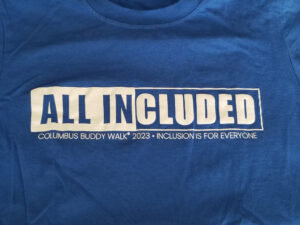
ALL INCLUDED
by Sally Duffy, SC, Board Chair
I can remember talking with my brother-in-law, John, shortly after my sister gave birth to their fourth child twenty-seven years ago. Ryan was born with Down syndrome and had a number of medical complications that were life-threatening. John was lamenting persons telling him how sorry they were about Ryan rather than congratulating him. John exclaimed to me, “Ryan is my son. I am as proud of him as my other three children.”
A few years later, Ryan’s oldest brother was upset because his high school teacher had said Ryan was retarded. Thankfully, my nephew respectfully told the teacher that “Ryan was not retarded and can learn, it just takes more time.”
“Retarded” is an outdated, offensive term formerly used to describe individuals with intellectual challenges yet have intellectual abilities.
We all have challenges and vulnerabilities; we all have God-given dignity and all are made in the image and likeness of God. Persons with intellectual, emotional, and physical challenges deserve an added layer of protection because they are vulnerable, like all of us, to exploitation, coercion, force, and fraud.
Ryan can teach all of us about being other-centered, greeting you with joy, not needing to win but to enjoy, always receiving a standing ovation, humility, and thanking people for participating and coming to an event. At our Irish wakes, Ryan always expresses his sorrow, empathy, and sadness, yet reminds us that the person is in heaven with Booma (his grandmother).
“People with disabilities [are]… especially vulnerable to human trafficking.” – U.S. Department of State, Trafficking in Persons Report (2016)
Polaris blog on 8/15/18 highlights that:
“The topic of human trafficking and disabilities is by no means “new” or emerging. Individuals with disabilities have not only been documented as victims of human trafficking in numerous criminal and civil cases, according to The Human Trafficking Legal Center, but some cases have prompted landmark changes to trafficking legislation and the ways in which we understand the crime itself.
Any vulnerable person is at risk for human trafficking; however, individuals with disabilities may face increased risk for several reasons. The Office for Victims of Crime Training and Technical Assistance Center details the vulnerabilities that increase the risk for individuals with disabilities to being trafficked. Some of them are outlined below:
- Traffickers may seek out victims with disabilities to gain access to their public benefits…
- Individuals with disabilities may require a caregiver to meet their basic needs and this caregiver can take advantage of this dependency and force them into prostitution or labor. Even if the caregiver is not the trafficker, people with disabilities may have a learned response to comply with caregivers’ wishes due to their dependence on them…
- Some individuals with disabilities may have difficulties with communication and/or speech. This may affect their ability to get help and report the abuse they are suffering, and could require them to depend on their trafficker for interpretation. For these victims, suffering in silence takes on a very literal meaning. Outside interpretation is critical.
- People with disabilities may be sheltered and isolated and therefore crave friendships and relationships…
- People with disabilities may be desensitized to touch due to isolation, a lack of informed sex education, or medical procedures related to their disability. They may be unaware of their right to object or reject unwanted touching. They may be unsure of what constitutes a crime and what their rights are as a victim of a crime.
- Traffickers may also target individuals with disabilities because of the social discrimination and prejudice they face. This can cause authorities and even their own family and friends to not believe victims when they report their abuse…”
United States State Department, Office to Monitor and Combat Trafficking in Persons. June 2024. Nothing About Us Without Us: Human Trafficking and Persons with Disabilities noted that: “Professors Andrea Nichols and Erin Heil have noted the “heightened risk as well as heightened prevalence” of human trafficking involving persons with disabilities, although the authors acknowledged the paucity of existing research. Even when research about persons with disabilities is conducted, it rarely addresses additional intersecting identities, such as race, ethnicity, age, gender, religion, sexual orientation, gender identity, gender expression, or migratory status that can exacerbate marginalization. The intersection between disability and human trafficking can be cyclical. On the one hand, persons with disabilities are more likely to be targeted by traffickers; on the other hand, the experience of being trafficked can lead to or exacerbate existing disabilities through physical injuries or emotional trauma that in turn could heighten vulnerability.”
More information and Resources are available here: https://alliancetoendhumantrafficking.org/wp-content/uploads/2021_06_Stop-Trafficking-EN.pdf